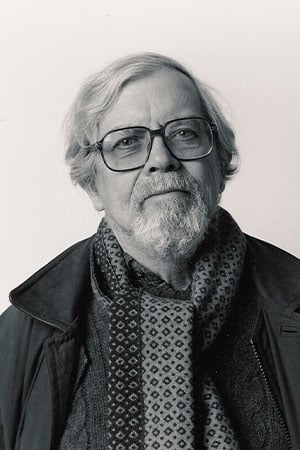
Robert Breer
Born in 1926 in Detroit, Robert Breer has spent fifty years building up a totally atypical body of work which plays with different genres and abolishes the notions of space and time. Starting off as a painter, he then deconstructed his neoplastic works and ended up with... Read full bio →
What Goes Up
Robert Breer’s What Goes Up... continues his “kitchen sink” approach of including as many different kinds of things as possible. Central to his art are a series of tensions. Rather than using animation to produce seamless illusions, his films reveal cinema’s dual nature as both an illusion of movement and a succession of stills.
Bang!
An experimental film in which a photograph of an airplane turns into a wire diagram, then into an animated plane in flight, and then it explodes into words.
Lmno
Conceivably the best of all of Breer’s films to date – has more to do with figuration, according to Breer’s formulation regarding titles with letters or numbers.
Fuji
A live action footage of a smiling, bespectacled (presumably) Western tourist set against the familiar cadence of an accelerating train revving up as it leaves the station sets the mesmerizing tone for the film's abstract panoramic survey of an Ozu-esque Japanese landscape of electrical power lines, passing trains, railroad tracks, and the…
Gulls and Buoys
An abstract view of a seacoast landscape, created by mixing original line drawings and rotoscoped imagery traced from live-action footage, presented against a sound track of seaside noises.
70
"Made with spray paint and hand-cut stencils, this film was an attempt at maximum plastic intensity… Places Breer for the first time among the major colorists of the avant-garde." – P. Adams Sitney
69
Robert Breer animation from 1969. 16mm, color, silent, using spray paint & stencils.
Fist Fight
Breer's extraordinary autobiographical film combines personal and family photos with intense colors, textures and geometric abstractions. Originally presented as part of Karlheinz Sotckhausen's 1964 premiere of Originale. - Harvard Film Archive
Breathing
Breer’s animation explores the theme and variation of the drawn line: a line in constant movement and transformation. With a very sketchy style, he demonstrates how a simple, abstract image can fill and satisfy the imagination of the film viewer. - MoMA
Pat's Birthday
Breer was influenced by the new performance art and "happenings" making waves in the avant-garde of Europe and New York. He worked briefly with Claes Oldenburg and his performance pieces resulting in a 13 minute film, Pat's Birthday (1962). - AWN
Homage to Jean Tinguely's 'Homage to New York'
A record, of sorts, of the birth and death of Tinguely’s famous auto-destructive sculpture. Filmed on the spot at MoMA, this film also exploits a wide range of camera and editing techniques to give it a life of its own, independent of and parallel to the subject. — Anthology Film Archives
Eyewash
A free flow from photography to geometric abstraction hand-painted by Breer. - Harvard Film Archive
Jamestown Baloos
Cut-outs of war machines and the figure of Napoleon – contributors to an anti-war theme – encounter abstract shapes, line drawings, old-master landscapes, short bursts of ‘real-time’ landscapes and shakily photographed gestural watercolors. … ‘a synthesis of all previous techniques.’
A Man and His Dog Out for Air
While birds can be heard singing a shrill song, lines crisscross wildly as if they aimed to form shapes. Their efforts seem hopeless until the very end.
Recreation
Featuring a commentary by Noël Burch (in nonsense French), Recreation's rapid-fire montage of single-frame images of incredible density and intensity has been compared to contemporary Beat poetry.
Motion Pictures
Experimental film, in which against a black field, constantly changing coloured strips of paper cross the screen, meet each other and deflect at angles.
Form Phases II
Breer's earliest experiments in animation are wonderfully dense yet lyrical abstractions based on Breer's own geometric paintings. - Harvard Film Archive
Form Phases
Breer's earliest experiments in animation are wonderfully dense yet lyrical abstractions based on Breer's own geometric paintings. - Harvard Film Archive