
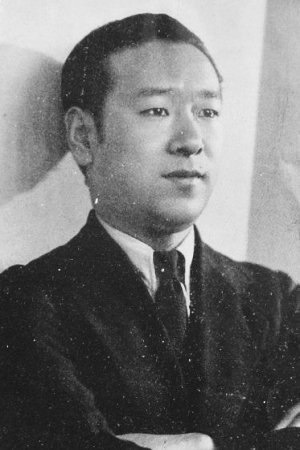
Masao Mishima
Featured Characters
Roles you can spot in Whatthemovie snapshots


Shin otoko wa tsurai yo
After winning big at the races, Torajiro Kuruma wants to take his aunt and uncle on a trip to Hawaii to partly pay the great filial debt he feels he owes them, but the plan hits a snag. Also, a pretty kindergarten teacher rents a room at Toraya.
Taiyô no ôji: Horusu no daibôken
Young Horus lives in a mythical Scandinavia of the Iron Age. Recovering the stolen Sword of the Sun from a rock giant, he learns he must travel to the lands of his ancestors, encountering the beautiful but enigmatic Hilda as his journey leads to a series of adventures.
Jôi-uchi: Hairyô tsuma shimatsu
The mother of a feudal lord's only heir is kidnapped away from her husband by the lord. The husband and his samurai father must decide whether to accept the unjust decision, or risk death to get her back.
Zatôichi umi o wataru
Our hero Zatoichi sails to one of the distant islands to begin a pilgrimage to a total of 88 Shinto shrines.
Akutarô-den: Warui hoshi no shita demo
A young man with a strong sense of justice is torn between two girls: the flighty Taneko and the serious Suzuko. With wisdom, courage and honor in a Japanese spirit of manliness he wins the day.
Adauchi
An innocuous comment during a weapon inspection wounds the pride of low-ranking samurai Shinpachi, leading to an argument with his superior. The situation snowballs out of control, leading to a deadly duel and political fallout which threatens the entire clan.
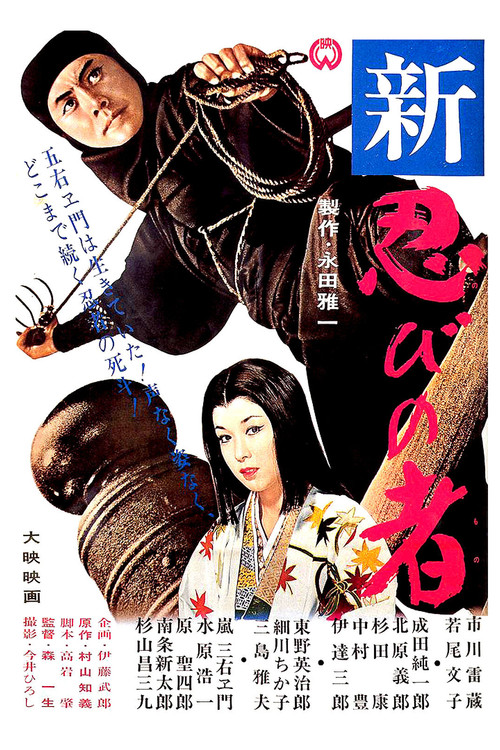
Shin shinobi no mono
[Period covered: 1595-1600] We last saw ninja Ishikawa Goemon, as he was about to be boiled alive. But a good ninja is both hard to find, and even harder to kill. With the help of the enigmatic Hattori Hanzo, Goemon lives to skulk another day, and sets his sights on bringing down the warlord who tried to turn him into soup – Toyotomi Hideyoshi.
Kuro no trademark
Ide of the Kokusai Rayon Company visits a supermarket and finds cheap shirts being passed off as his company's products. But a closer look reveals that the last letter of "Kokusai" has been changed to "n" and reads "Kokusan." The buyers, however, are all under the impression that they are buying Kokusai shirts.
Seppuku
When a ronin requesting seppuku at a feudal lord's palace is told of the brutal suicide of another ronin who previously visited, he reveals how their pasts are intertwined - and in doing so challenges the clan's integrity.
Gan no tera
Satoko is a mistress by trade or fate: when her master, the silkscreen artist of the Kohoan Temple in Kyoto, dies, she is given to the temple's lascivious head priest Kikuchi. She is drawn to a melancholy young acolyte, Jinen, who has observed the profligacy of his cruel master and Satoko's utter dependence on the man.
Buta to gunkan
In the city of Yokosuka, Kinta and his lover Haruko, both involved with yakuza, brave the post-occupation period with a goal to be together.
Tokyo no abarenbô
Mega star Akira Kobayashi stars as Jiro in the rambunctious tale of a chef who opens a restaurant in the busy Ginza district. His culinary skills and dashing good looks bring in the women as well as unwanted trouble, while an explosive political scandal builds around his girlfriend’s business...
Rokudenashi
Yoshida's first feature follows the lives of young students against a background of jazz, emptiness and boredom. The plot is fairly simple: a "good-for-nothing" from a poor background falls in love with the young secretary of his rich friend's father. The woman senses good in him and tries to lead him on the right path.
Ningen no jôken (I)
The Human Condition is a Japanese epic film trilogy made between 1959 and 1961. The trilogy follows the life of Kaji, a Japanese pacifist and socialist, as he tries to survive in the fascist and oppressive world of WWII-era Japan. No Greater Love (1959) opens with Kaji marrying his sweetheart Michiko despite his misgivings about the future.
Kaii Utsunomiya tsuritenjô
Ryutaro is a spy employed by the shogun Tokugawa Iemitsu, who is the target of assassination attempts that aim to hand power over to his younger brother Tadanaga.
Okaasan
A teenaged girl witnesses her widowed mother's attempt to sustain her family.
Zoku aoi sanmyaku
Continuation of The Blue Mountains: Part I. Released a week later.
Banshun
Noriko is perfectly happy living at home with her widowed father, Shukichi, and has no plans to marry -- that is, until her aunt Masa convinces Shukichi that unless he marries off his 27-year-old daughter soon, she will likely remain alone for the rest of her life.
Aoi sanmyaku
Teacher Yukiko finds herself in opposition to conservative faculty and villagers after defending a student for being in a relationship with a young man from Tokyo.
Tsuzurikata kyôshitsu
Masako, the daughter of an impoverished itinerant tinsmith, wins a grammar school composition contest with an essay about her neighborhood. The much publicized essay ends up causing the family problems and their chronic money troubles threaten Masako's further education.