
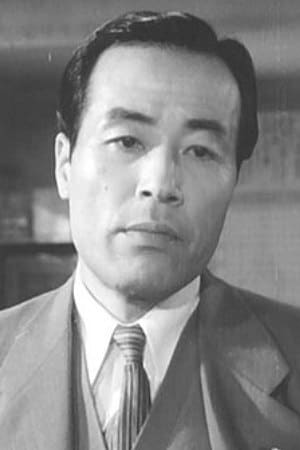
Eitarō Ozawa
Eitaro Ozawa (小沢 栄太郎, Ozawa Eitarō, 27 March 1909 – 23 April 1988) was a Japanese actor. He appeared in more than 200 films between 1935 and 1988.
Featured Characters
Roles you can spot in Whatthemovie snapshots




Marusa no onna
Intrepid tax investigator Ryoko Itakura sets her sights on the mysterious and philandering Hideki Gondo, a suspected millionaire and proprietor of a thriving chain of seedy hourly hotels, who has for years succeeded at hiding the true extent of his assets from the Japanese authorities.
Godzilla 1985
Originally released in Japan as "The Return of Godzilla" in 1984, this is the heavily re-edited, re-titled "Godzilla 1985".
Gojira
After a fishing boat is attacked, the sole surviving crew member realizes it is none other than a resurrected Godzilla. However, efforts to bring the story to light are suppressed by the Japanese government amid growing political tensions between the United States and the Soviet Union, who are both willing to bomb Japan to stop the monster.
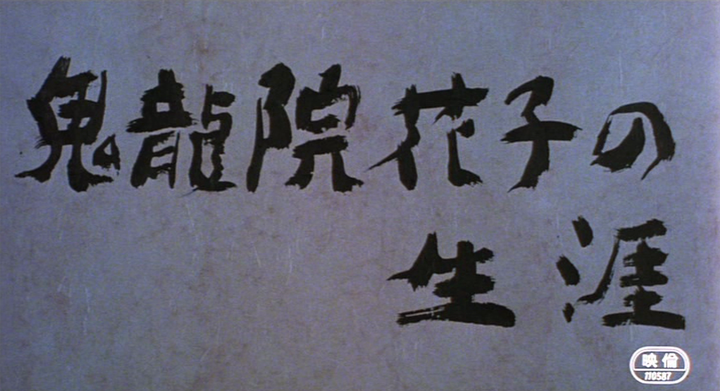
Kiryûin Hanako no shôgai
Onimasa is the egocentric boss of a small yakuza clan on Shikoku Island, whose criminal duties conflict with his self-image as a chivalrous samurai. His struggles with his boss, the Shikoku Godfather, and the tumultuous life of his adopted daughter, Matsue, form the backdrop of this epic tale of justice, obedience, and bloody vengeance.
Byoinzaka no kubikukuri no ie
This time, Kousuke investigates a murder in a hospital. The murderer leaves misleading evidence to divert Kousuke's attention on the case. Suspicion and doubt clouds Kousuke's mind.
Inugami-ke no ichizoku
When a tycoon passes away, he unexpectedly leaves the family fortune to outsider Tamayo on the condition that she marries one of the grandsons, pitting blood against blood.
Sandakan hachibanshokan bohkyo
A young journalist interviews an elderly woman about being forced into prostitution in Borneo at a brothel called Sandakan No. 8.
Gishiki
Oshima’s magisterial epic, centering on the ambivalent surviving heir of the Sakurada clan, uses ritual and the microcosm of the traditional family to trace the rise and fall of militaristic Japan across several decades.
Kuro bara no yakata
When wealthy Kyohei hires singer "Black Rose" to perform in his exclusive club, he gets more than he bargains for when she attracts scores of homicidal past lovers. The film takes a bizarre twist when Kyohei's son falls victim to the femme fatale's unique charm.
Goyôkin
Magobei Wakizaka is a samurai overcome with guilt over his unwitting part in a massacre of a small village. Now a ronin, he learns of a scheme by his old clan to repeat the same crime. Determined to stop them, he endures great hardships in an attempt to atone for his earlier mistakes.
Nemuri Kyôshirô: Onna jigoku
Two devious retainers are competing to take control of a fief when the current Lord dies, but involving Kyoshiro in the conflict against his will is the textbook example of a bad idea - especially when the collateral damage starts to tick him off.
Zatôichi chikemuri kaidô
After an artist is threatened by the yakuza into creating valuable but highly illegal pornography, the law aims to execute him. Zatoichi, having been honor bound to protect the man and his family, must now run against the law.
Ibun Sarutobi Sasuke
Years of warfare end in a Japan unified under the Tokugawa shogunate, and samurai spy Sasuke Sarutobi, tired of conflict, longs for peace. When a high-ranking spy named Tatewaki Koriyama defects from the shogun to a rival clan, however, the world of swordsmen is thrown into turmoil.
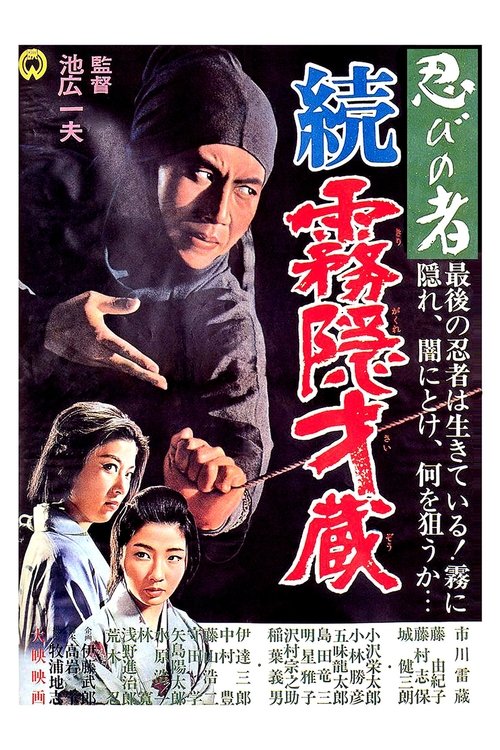
Shinobi no mono: Zoku Kirigakure Saizô
In part five of the 8-part Shinobi No Mono Ninja film series the heroic ninja Kirigakure Saizo (Raizo Ichikawa, of Sleepy Eyes of Death fame) serves the daimyo Sanada, played by Lone Wolf and Cub star Tomisaburo Wakiyama. They are assaulted by Ieyasu and his soldiers.
Ansatsu
John Chandler is sentenced to death but will by the CIA at the last minute chance to re-emerge as his own brother Phillip. This is because the CIA then be able to use him to become a double spy. A classic euro-spyfilm.
Kuro no hôkokusho
After a businessman is murdered, an investigation identifies a suspect who is then put on trial for that crime.
Yôsei Gorasu
In 1976, a drifting star named Gorath is discovered to be on a collision course with Earth. Although it is smaller than Earth, its enormous mass is enough to destroy the planet totally. A mission sent to observe Gorath is destroyed after the ship is drawn into the star, with a later mission barely escaping the same fate.
Koiya koi nasuna koi
A court fortune-teller loses his mind after a conspiracy leads to the death of his lover. Hope appears to be on the horizon after he becomes romantically involved with his dead lover’s twin sister, but more complications arise thanks to a chance encounter with a clan of shape-shifters.
Tsuma wa kokuhaku suru
Tied to a mountain between her brutalizing spouse and her secret lover, disaster strikes; the authorities accuse her of murder and prompt a confession.
Taiyô no hakaba
In Osaka's slum, capricious folks without futures engage in pilfering, assault and robbery, prostitution, and the trading of ID cards and blood.
Onna ga kaidan wo agaru toki
Keiko, whom everyone calls Mama, narrates her story: she's a hostess on the Ginza, 30, a widow. She describes life's vicious cycle: acting cheerful around drunks, dressing and living well to convey confidence, needing money for these expenses and for her demanding mother and brother, and knowing she's growing older.
Ningen no jôken (I)
The Human Condition is a Japanese epic film trilogy made between 1959 and 1961. The trilogy follows the life of Kaji, a Japanese pacifist and socialist, as he tries to survive in the fascist and oppressive world of WWII-era Japan. No Greater Love (1959) opens with Kaji marrying his sweetheart Michiko despite his misgivings about the future.
Bijo to ekitai ningen
Fallout from hydrogen bomb tests is turning people into blobs of oozing, radioactive green goop that travel through sewers and have a taste for human flesh, in "The H-Man" (1958). Kenji Sahara, Akihiko Hirata star.
Kuchizuke
Kinichi and Akiko meet when they visit their fathers in prison. After successfully gambling on a bicycle race, they spend an enjoyable day together at the beach.
Kabe atsuki heya
A group of rank-and-file soldiers are jailed for crimes against humanity, themselves victims of a nation refusing to bear its burdens as a whole.
Yôkihi
In 8th-century China, the Emperor grieves the death of his wife. The Yang family wants to provide the Emperor with a consort so that they may consolidate their court influence. General An Lushan finds a distant relative working in their kitchen, whom they groom to present to the Emperor.
Miyamoto Musashi
Starring Toshiro Mifune as Musashi Miyamoti, this first film in Hiroshi Inagaki's Samurai Trilogy won a 1956 Honorary Oscar for Best Foreign Film. Struggling to elevate himself from his low caste in 17th century Japan, Mayamoto trains to become a mighty samurai warrior. In the film's bracing climax, Miyamoto finally gets a chance to prove himself.
Chikamatsu monogatari
When the wife of a 17th-century Kyoto scrollmaker is falsely accused of having an affair with his best employee, the pair flee the city and find themselves truly falling for one another.
Ugetsu monogatari
In the civil wars of 16th century Japan, two ambitious peasants want to make their fortunes. The potter Genjuro intends to sell his wares for vast profits in the local city, while his brother-in-law Tobei wishes to become a samurai.
Inazuma
The story of Kiyoko, a young woman who has successfully managed to make a break with her dysfunctional family who have been trying to arrange a marriage for her with a disagreeable man whom she has rejected.
Karumen kokyô ni kaeru
A girl who had left her home village for life in Tokyo returns to her home years later, and evokes a scandal when the locals discover that she's a stripper.
Shûbun
Akira Kurosawa directed this drama about a paparazzi photo that a tabloid magazine spins into a scandalous story and soon sparks a court case.
Waga koi wa moenu
In 1880s Japan, women's struggle for equality rages on. Eiko Hirayama leaves Okayama for Tokyo, where she helps the fledgling Liberal Party and falls in love with its leader Kentaro Omoi, just as the party is being disbanded by the government.
Nagaya shinshiroku
An errant salaryman's son gets lost until a man from the Tokyo tenements brings him to vendor Tane, who's reluctant to let the kid board.
Ôsone-ke no ashita
A Japanese family weathers much hardship after their military uncle comes to live with them during WWII.
Hana saku minato
The sweet but naive denizens of a charming port town are hoodwinked by a couple of con men at the outset of World War II. But the hustlers’ plan backfires when they come down with severe cases of conscience.